How to Help Baby Toddler Eat With Sensory Processing Disorder
This post may contain affiliate links which won't change your price but will share some commission.
Are meal times a boxing? Is your child'due south diet limited due to flavors and textures? Is chewing a job? Would a delicious treat like leftover muffin bread pudding exist out of the question because it's "as well mushy?" Take heart! I've got the best strategies for feeding a kid with oral sensory issues.
I have two kids with oral sensory bug. But I didn't even know it until I wrote this post! To clarify, nosotros've been working on my daughter'south sensory issues since she was a baby. Simply I didn't realize some of my son'south behavior was related to sensory bug until I did more than research.
Why is that? They are at the opposite ends of the spectrum. Some kids with oral sensory bug fear stimulation. It is the most obvious with refusal to chew, eat, etc. That is my oldest. I still remember being so excited to feed her solid food when she was vi months former. Such a milestone with your first child! Merely it did not become also every bit I had hoped. Everything came correct back out. Little did I know we'd be battling that problem ten years after!
Some kids crave stimulation, similar my son. He eats pretty well…but he always stuffs as much food in his mouth as possible and is constantly chewing on things (not-food items like dress, toys and his hands). He seeks out oral stimulation. Possibly that's why he loved nursing and so much! Though he really had no involvement in solid food until nearly ten months old.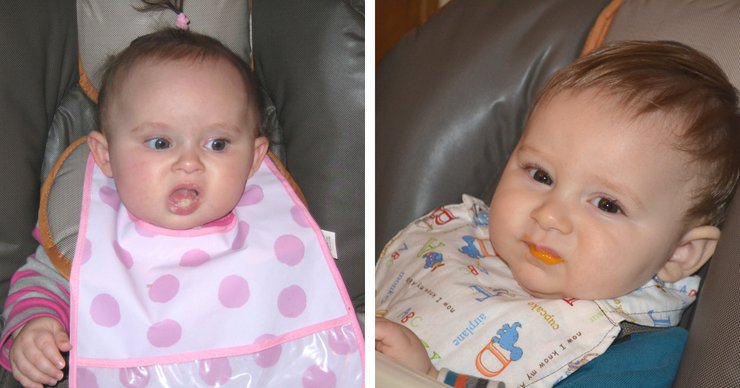
What is Oral Sensory Processing Disorder?
Equally you can see there is such a divergence just between two kids in the same family. So you lot tin imagine that the spectrum of oral sensory issues is quite broad. Hither are some of the common symptoms.
The child…
- won't use utensils/eats with his easily
- won't stay in a chair during a meal
- puts more food in his oral fissure than fits
- chews with her oral fissure open
- chews with her forepart teeth
- chews on toys and clothes
- holds food in her oral fissure for a long period of time
- will only consume sure textures, sizes, shapes or colors of food
- gags on nutrient easily
- refuses to effort new foods
- is afraid of eating
- pushes food frontward with his tongue instead of dorsum
As if getting kids to eat a nourishing diet wasn't hard plenty. When you add together Oral Sensory Processing Disorder it just compounds the problem. But take heart. It can be done! It but takes some piece of work figuring out how all-time to meet your kid's needs.
I have a collection of strategies for feeding kids with all sorts of challenges. Some are uncomplicated tricks to endeavour at home. Some require aid from therapists and doctors. Beginning with one and go on working through the listing to figure out what works best for yous. I'll share our ain successful strategies as well.
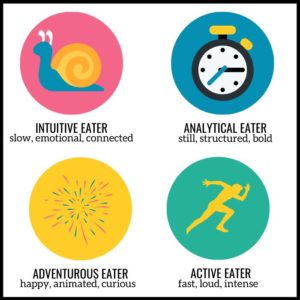
Also go along in mind that every child has a unique Eating Style that dictates how they eat. What seems similar a sensory consequence could in fact just be how they express themselves through eating. Larn more near your kid's Eating Style HERE!
At-dwelling house Tools for Feeding a Child with Oral Sensory Processing Disorder
- Try unlike textures.
It goes without saying that food texture is a huge obstacle with sensory issues. Mushy, chewy, crunchy, crispy liquid, solid. I'm sure your kid has a multitude of categories. Figure out what textures your child is comfy with and serve those foods first. Gradually endeavour introducing new textures. Just one bite at a time is sufficient. Go at your child'southward pace. You don't want to make eating stressful or scary. Over time y'all can try larger quantities. If your kid is a fan of smoothies I've got tons of healthy ones in my book Easy Nourishment for Picky Eaters. - Let kids play with food.
One of the best ways to get a kid with oral sensory issues comfy with a detail food is to let them play with it. Create a lunch with various dips, spreads and crackers. Make a snack of fruits and veggies and let them make a picture out of it. Don't put any pressure on the kid to swallow it. Merely permit them have fun creating things.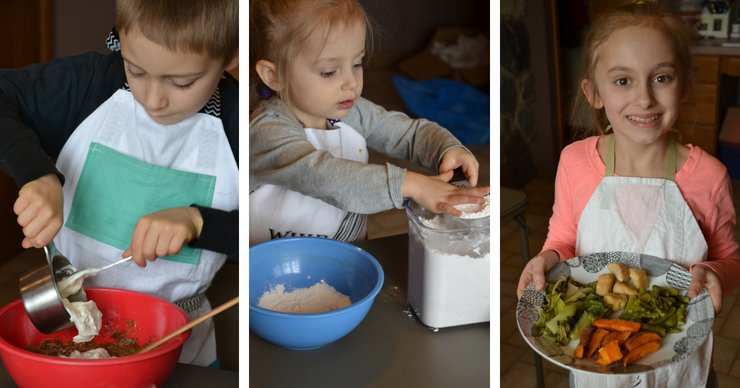
- Teach kids to melt.
This is ane of my favorite strategies. Non only does education your child to cook oftentimes get them to try new foods, information technology also sets them up for success as an adult. They'll get feeding therapy and life skills all in one! We've been using the Kids Cook Real Food ecourse for over ii years now. It has been amazing to sentinel my kids build conviction with their skills and exist willing to try then many foods! It's a win-win. - Make meals fun.
Information technology never hurts to cater to a child's playful nature. Effort fun straws for drinking smoothies and pureed soups. Cut sandwiches into shapes. Utilise an array of cups with dissimilar shapes and textures. Or perhaps go a new loving cup or straw equally a prize for trying something new. Relate a meal to a story yous just read (i.due east. porridge from Goldilocks). Annihilation to acquaintance eating with fun. - Practise the rima oris.
For some kids the physical act of eating is truly hard. Exercises can assistance train their muscles. Kind of similar lifting weights for your mouth. Have them practice sucking from a straw, blowing bubbles, making sounds, chewing chewy and crunchy food. Anything that gets their mouth moving in unlike means. - Use dissimilar utensils.
Information technology drives my husband and I crazy that our two oldest rarely employ utensils unless we tell them (force them!) to. I never really idea virtually how the utensils feel to them. Or that they could be challenging to manipulate (especially since our three-twelvemonth former uses them so well!). If this is the case for your kids experiment with spoons and forks of different materials, sizes and shapes. Notice something your child is comfortable putting in his rima oris. - Experience food away from meals.
Kids acquire that they are expected to consume at meal times. Which creates force per unit area and sometimes anxiety. Offer your child exposure to food away from a repast time, without expectations. Give her a plate of fruits and veggies to snack on every bit she pleases. Let her play with them. Make sure she knows she tin can eat the nutrient if she wants or leave it all there. It'due south up to her. This will help her relax and build confidence. - Apply body movement before eating.
Another struggle for my kids is sitting in a chair to swallow. Some kids just need to motility to satisfy their need for stimulation. Body movement earlier a meal can help this. Before coming to the table accept them try some jumping, rocking, hanging or climbing. Other forms of impact that might assist are hugs and being wrapped in a blanket. Ease their senses first. So start the meal. Or let them stand or sit on a residue ball to swallow. - Use chew toys.
It may audio strange, but some kids just need to chew! They demand constant oral stimulation. They can't eat non-terminate (though sometimes it seems they effort to!). Processed and gum are non healthy options. A simple solution is a chew toy. There are special ones designed for older kids/kids with oral sensory issues. I'k tempted to go one for my son and so he'll stop putting his hands and toys in his mouth. For a long time I thought possibly he was cut molars. But after a few years of the behavior I know he just needs oral stimulation.
- Experiment with flavors.
Generally kids with oral sensory issues need very bland and mild-flavored food. But that isn't always the example. Some kids like a lot of spice. Talk to your kid and experiment with unlike flavors. Salty, sweet, spicy, bitter, assuming, mild. My oldest tin can't handle any spice. Merely she loves tons of table salt. My son, on the other paw, enjoys spicy food. Again, that difference betwixt sensory avoidance and sensory stimulation is obvious. - Improve gut wellness.
Oral sensory issues are related to the nervous system, which is controlled past the brain. A nervous system dysfunction often points to leaky gut, where strange invaders (such every bit food particles and toxins) leak through the intestines and cause an immune response. They also impact proper part of the encephalon. The solution is to work on gut health. This can include daily probiotics, digestive support like enzymes and sometimes a specific diet (remove allergens, elimination nutrition, rotation diet, etc.). - Stick to a schedule.
Kids with sensory issues like routine. They want to know what to expect. They fear unknowns. Sticking to a regular eating schedule can be calming. They know when nutrient is coming and when they are expected to eat. It is important to proceed upward the routine even on weekends, vacations, etc.
 Testing and Therapy for Oral Sensory Processing Disorder
- Orthodontic work to correct the palate.
Oral sensory issues frequently coincide with structural issues with the oral fissure. Orthodontic work to expand the palate can assistance make the physical procedure of chewing and swallowing easier. Information technology volition also help with proper breathing. While traditional orthodontics may assistance, we found that Orthotropics was much more than effective. You lot can read our story here. - Speech and occupational therapy.
Sometimes oral sensory issues point to a lack of proper reflex integration. All reflexes of the torso should integrate during infancy if the child is developing properly. But it doesn't always happen. My oldest however has her tongue thrust reflex, meaning she pushes food forward with her tongue instead of back to the throat for swallowing. Both speech communication and occupational therapy can help get all of the reflexes integrated properly and train the oral cavity to chew well. - Craniosacral therapy, chiropractic intendance and functional neurology.
All of these therapies focus on the whole body structure and how things work together. Tension in the cervix and spine tin cause the tongue to feel restricted, making chewing difficult. Getting the whole trunk in alignment and loosened will permit your child relax and have an easier time eating. We have used all 3 of these therapies to help with breastfeeding problems and sensory problems in older kids.
- Vitamin and mineral deficiencies and imbalances.
Nourishing nutrient is a must when dealing with oral sensory issues. The root problem can be a vitamin and mineral deficiency and/or imbalance. It can also be related to heavy metals. Pilus tissue mineral analysis is the best mode to find out where your child is defective and develop a plan for supplementation and dietary changes. Some elementary supplements to start with are probiotics and digestive enzymes. These are beneficial to all children. - Tongue and lip ties.
Revising a tongue and/or lip necktie can give a child more than ability to chew and swallow properly. It will also improve speech and overall oral construction. Find a preferred provider (that treats with laser) to do the evaluation. A tongue tie may not exist obvious to you lot.
Oral Sensory Feeding Problems
If your child is struggling with eating due to oral sensory issues there is a lot you lot can do to help! Try a few of the at-dwelling house strategies. And don't be afraid to seek help from professionals. It can be life-irresolute for both y'all and your child.

Looking to dig fifty-fifty deeper into your child's feeding struggles? I've got more than tips and strategies in my book Why Won't My Child Eat?!. Catch your re-create here!

Information technology's always helpful to figure out your child'south Eating Style to run across their unique needs.
You can also assess your child's mouth function with my Mouth Function Assesment Guide HERE.

Would you prefer 1:1 support? See if Nutritional Therapy + HTMA is right for you!
Have y'all tried whatever of these strategies for oral sensory feeding issues? Do you apply others?
I'd love to hear what works for you!
Source: https://justtakeabite.com/2022/01/25/feeding-child-oral-sensory-issues/
0 Response to "How to Help Baby Toddler Eat With Sensory Processing Disorder"
Post a Comment