How to Read Gas and Oil Mix

How to mix 2 stroke fuel
Dissimilar a iv-stroke engine, a unique characteristic of a ii-stroke engine is that they practise non have an internal oil reservoir. Instead, 2-stroke engines require the owner to mix oil into the fuel at a predetermined ratio in club to ensure the engine receives adequate lubrication during operation.
Ii-stroke engine lubrication
The first true two-stroke engines were introduced more than a century ago and used to power motorcycles. These days, you'll find two-stroke engines in all kinds of equipment, such as chainsaws, grass trimmers and hedge trimmers, largely because ii-stroke engines have fewer moving parts, generate less oestrus and are in many means more efficient for their size.
When it comes to engine lubrication, the difference betwixt a ii-stroke and four-stroke engine is that a two-stroke engine has no valve train, timing gears, cams or pushrods, whereas four-stroke engines do. A four-stroke engine needs to broadcast oil throughout to lubricate these moving parts, where as a ii-stroke engine simply needs to lubricate the components internal of the combustion chamber, which tin can exist achieved by simply mixing oil in to the fuel information technology runs on.
Starting with a safe fuel storage container
The leading crusade of contaminated fuel in Commonwealth of australia is dirty fuel storage containers. For this reason, information technology is essential fuel is stored in a make clean container specifically designed to conduct fuel.
While fuel jerry cans are great, newer specialist fuel containers to the market such as the Husqvarna Combi Can have been designed to make storage safer and refueling less messy, thank you to inclusions such every bit the no spill valves, on-board tool storage and dedicated tank for ii-stroke oil.

Choosing the correct unleaded fuel
When selecting the blazon of unleaded fuel you use, yous'll need to consider the post-obit.
Only Husqvarna HP or LS+ two stroke oil should exist used in Husqvarna products. Husqvarna HP two-stroke oil must be used when mixing E10 fuel. Husqvarna LS+ oil should be used when mixing regular unleaded fuel.

Here'southward a handy tabular array that helps explain what 2-stroke oil to utilise with each type of fuel.

Choosing the right two-stroke oil
You've got your clean, empty fuel tin and a practiced supply of fresh petrol. Now information technology's time to make the about important call of them all - choosing the right oil for your ii-stroke fuel mix. Husqvarna offers two types of ii-stroke oil:
High Performance, HP oil: (544 0158-09, 1 litre dosage bottle)
Husqvarna's HP two-stroke oil is formulated to work well with depression-quality fuels. Carefully selected components in this part synthetic oil gives a cleaner engine and less coating on the piston/cylinder walls, exhaust port and crankcase.
Two Stroke, LS+ oil: (578 0370-02, 1 litre carton of 12)
The Low Smoke+ oil is a mix of mineral and constructed oils. This oil gives very low fume emissions, especially of import when used in products often run in densely congenital up areas. It also provides a lower engine temperature which extends the engine'south life. The formulation used in Husqvarna Low Fume + oil besides provides seizure protection, both against lean as well as carbon related piston seizures.
Equally a general warning, never use two-stroke oil intended for water-cooled engines in a not water-cooled engine. Sometimes referred to as Outboard oil (rated TCW). And also never use oil intended for 4 stroke engines.
Mineral oils usually price less than synthetics and are bang-up for engine lubrication. While oils made from a natural petroleum base do a off-white chore of cleaning and filtering engine contaminants, they can leave behind heavier deposits than their synthetic counterparts.
Over fourth dimension, you lot may end upward with burnt carbon or sticky residue buildup on the piston which can lead to more maintenance and compromised operation. Then manufacturers ofttimes mix in additives that help improve combustibility.
Total constructed oils demonstrate superior combustion characteristics on top of delivering great lubrication. With picayune to none of the mess that a petroleum based oil can exit backside, leaving you with a much cleaner engine. They're generally formed from a mineral base. Plus additives similar octane enhancers, detergents and stabilisers to help fire cleaner than other engine oils. And produce much less smoke.
Semi-constructed oil meets y'all in the center. They're primarily comprised of loftier-quality mineral oil. But mixed with additives and synthetic polymers to evangelize a cleaner burn than a strictly petroleum based product. Semi-synthetics cost less than full synthetic oils, offer good combustion properties and give you better lubrication than you'd get from a standard, low quality mineral oil.

2-stroke fuel ratios explained
It's important to go your fuel-to-oil ratios right when mixing 2-stroke fuel. Too much oil, and your engine may struggle to start or run, generate carbon buildup on engine internals, blow clouds of fume and perform poorly in full general. Likewise lilliputian oil, and your engine may sustain permanent internal damage and overheat.
Husqvarna two stroke engines require a two stroke oil designed and formulated for high functioning, air-cooled two stroke engines. Husqvarna two stroke engines are designed to run on clean, fresh, unleaded petrol.
The correct mixing ratio for your Husqvarna is detailed in the warranty handbook.
As a full general guide, a fuel / oil ratio of fifty:1 is recommended in Husqvarna products upwards to and including 75cc. In certain heavy utilize applications, models higher up 75cc may exist run on a mix of 33:1.
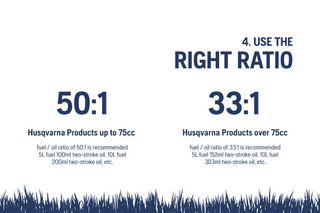
Besides consider;
- 50:ane (two%) with Husqvarna ii-stroke oil
- 33:1 (3%) with oils class JASO FB or ISO EGB for air-cooled, two stroke engines.
- Mixed fuel must exist used within 30 days from the time information technology was mixed to ensure the fuel is stable and combustible.

To make mixing your two-stroke easier, this 2-stroke fuel to oil ratio conversion nautical chart volition help you summate exactly how many parts fuel yous need for every part oil.
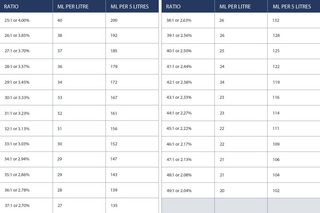
Top tips for mixing two-stroke fuel
- Avoid storing mixed two-stroke fuel for more than than 1 month.
- If you do need to prolong the life of your ii-stroke fuel mix, there are fuel stabilisers that can exist added which may extend the shelf life upward to twelve months. Read the label carefully.
- E'er make clean your cap and the surrounding surface area before filling up to prevent dirt and debris from falling into your tank.
- Use a make clean airtight container intended for fuel. Not but will it prolong the shelf life of your fuel mix, but it tin also help foreclose spillage, permeation and evaporation.
- Ever offset past filling one-half the amount of the petrol to exist used. Then add together the unabridged corporeality of oil. Mix (shake) the fuel mixture. Add the remaining amount of petrol.
- Don't get out premixed two-stroke fuel in any tool for an extended menses of time. Drain tanks and run your tool out of fuel earlier putting it away.
- Get yourself a modest, separate jerry can to store your two-stroke fuel in. So as never to confuse it with your regular, unleaded fuel used in 4-stroke engines.
- Always consult your nearest Husqvarna dealer if you are unsure about the correct use of your two-stroke product.


Related articles
Source: https://www.husqvarna.com/au/learn-and-discover/how-to-mix-2-stroke-fuel/
0 Response to "How to Read Gas and Oil Mix"
Post a Comment