what happens to sodium chloride when an electron is removed?
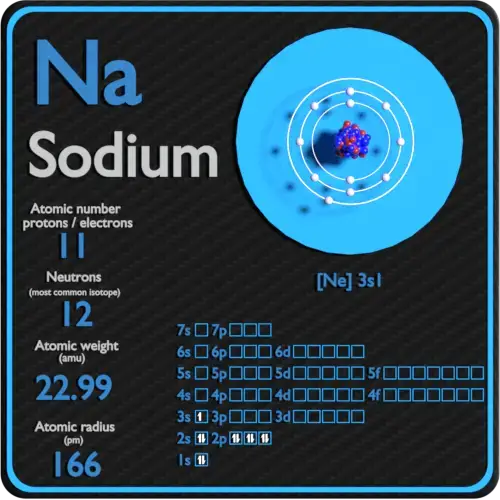
Sodium is a soft, silvery-white, highly reactive metal. Sodium is an alkaline metal, being in group 1 of the periodic tabular array, because it has a single electron in its outer shell that information technology readily donates, creating a positively charged atom—the Na+ cation.
Metallic sodium is used mainly for the production of sodium borohydride, sodium azide, indigo, and triphenylphosphine. Employed just in rather specialized applications, only about 100,000 tonnes of metallic sodium are produced annually. Sodium is now produced commercially through the electrolysis of molten sodium chloride.
Protons and Neutrons in Sodium
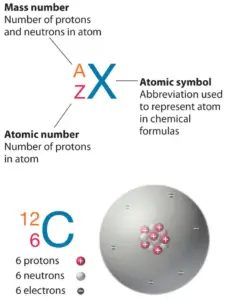 Sodium is a chemical element with diminutive numberxi which means at that place are 11 protons in its nucleus. Total number of protons in the nucleus is called theatomic number of the atom and is given thesymbol Z. The total electrical charge of the nucleus is therefore +Ze, where e (unproblematic accuse) equals toi,602 x 10-19 coulombs.
The total number of neutrons in the nucleus of an atom is called theneutron number of the atom and is given thesymbol N. Neutron number plus atomic number equals atomic mass number:N+Z=A. The departure between the neutron number and the diminutive number is known as theneutron backlog: D = N – Z = A – 2Z.
For stable elements, there is normally a variety of stable isotopes. Isotopes are nuclides that take the same diminutive number and are therefore the same chemical element, simply differ in the number of neutrons. Mass numbers of typical isotopes of Sodium are23.
Main Isotopes of Sodium
Its merely stable isotope is23Na. 2 radioactive, cosmogenic isotopes are the byproduct of catholic ray spallation: 22Na has a half-life of two.half dozen years and 24Na, a half-life of xv hours; all other isotopes accept a half-life of less than ane minute.
Sodium-23 is equanimous of 11 protons, 12 neutrons, and 11 electrons. Astute neutron radiation exposure (e.thou., from a nuclear criticality accident) converts some of the stable 23Na in human blood plasma to 24
Na. By measuring the concentration of this isotope, the neutron radiation dosage to the victim tin be computed.
Sodium-22 is composed of eleven protons, xi neutrons, and xi electrons. odium-22 is a radioactive isotope of sodium, undergoing positron emission to 22Ne with a half-life of 2.605 years. It is also unremarkably used every bit a positron source in positron annihilation spectroscopy.
Sodium-24 is composed of 11 protons, 12 neutrons, and eleven electrons. Sodium-24 is one of the most important isotopes. It is radioactive and created from common sodium-23 past neutron bombardment. Therefore its activity accounts for virtually of the reactor coolants activity when reactor is at total power.
Electrons and Electron Configuration
The number of electrons in an electrically-neutral cantlet is the same as the number of protons in the nucleus. Therefore, the number of electrons in neutral atom of Sodium is xi. Each electron is influenced by the electric fields produced by the positive nuclear accuse and the other (Z – ane) negative electrons in the atom.
Since the number of electrons and their arrangement are responsible for the chemical beliefs of atoms, theatomic number identifies the various chemical elements. The configuration of these electrons follows from the principles of breakthrough mechanics. The number of electrons in each chemical element'south electron shells, specially the outermost valence shell, is the primary cistron in determining its chemical bonding behavior. In the periodic tabular array, the elements are listed in society of increasing atomic number Z.
Electron configuration ofSodiumis[Ne] 3s1.
Possible oxidation states are-1; +ane.
Sodium atoms accept 11 electrons, 1 more than the stable configuration of the noble gas neon. Sodium unremarkably forms ionic compounds involving the Na+ cation. Sodium is ordinarily quite reactive with air, and the reactivity is a function of the relative humidity, or h2o-vapour content of the air. The corrosion of solid sodium by oxygen likewise is accelerated by the presence of pocket-sized amounts of impurities in the sodium. In ordinary air, sodium metal reacts to form a sodium hydroxide film, which tin can speedily absorb carbon dioxide from the air, forming sodium bicarbonate.
Sodium metal tin can be hands cut with a knife and is a good conductor of electricity and heat because it has only ane electron in its valence trounce, resulting in weak metal bonding and free electrons, which carry energy.
Most Common Compound of Sodium
Salt is mostly sodium chloride, the ionic compound with the formula NaCl, representing equal proportions of sodium and chlorine. Sea salt and freshly mined salt (much of which is bounding main common salt from prehistoric seas) as well contain small amounts of trace elements (which in these minor amounts are generally proficient for plant and animate being wellness.
About Protons
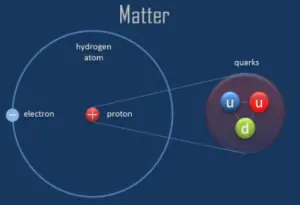 A proton is 1 of the subatomic particles that brand up affair. In the universe, protons are abundant, making upabout one-half of all visible thing. Information technology hasa positive electric charge (+1e) and a residuum mass equal to one.67262 × ten−27 kg (938.272 MeV/c two )— marginally lighter than that of the neutron but nearly 1836 times greater than that of the electron. The proton has a mean square radius of almost 0.87 × 10⁻¹⁵ 1000, or 0.87 fm, and information technology is a spin – ½ fermion.
The protons exist in the nuclei of typical atoms, along with their neutral counterparts, the neutrons. Neutrons and protons, normally chosennucleons, are bound together in the atomic nucleus, where they account for 99.9 percentage of the atom's mass. Research in high-free energy particle physics in the 20th century revealed that neither the neutron nor the protonis not the smallest building block of affair.
About Electrons and Electron Configuration
The periodic table is a tabular brandish of the chemic elements organized on the basis of their diminutive numbers, electron configurations, and chemical properties. The electron configuration is the distribution of electrons of an atom or molecule (or other physical structure) in atomic or molecular orbitals. Knowledge of theelectron configuration of different atoms is useful in understanding the structure of the periodic table of elements.
Every solid, liquid, gas, and plasma is composed of neutral or ionized atoms. Thechemical properties of the atom are adamant by the number of protons, in fact, by number andarrangement of electrons. Theconfiguration of these electrons follows from the principles of quantum mechanics. The number of electrons in each element's electron shells, particularly the outermost valence shell, is the principal gene in determining its chemical bonding beliefs. In the periodic tabular array, the elements are listed in order of increasing atomic number Z.
Information technology is thePauli exclusion principle that requires the electrons in an atom to occupy unlike free energy levels instead of them all condensing in the ground land. The ordering of the electrons in the ground country of multielectron atoms, starts with the lowest energy state (ground state) and moves progressively from there up the free energy scale until each of the cantlet'south electrons has been assigned a unique prepare of quantum numbers. This fact has key implications for the building up of the periodic tabular array of elements.
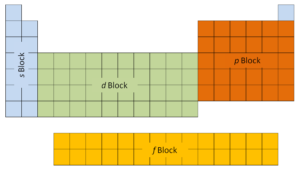 The first 2 columns on the left side of the periodic tabular array are where thes subshells are beingness occupied. Because of this, the first ii rows of the periodic table are labeled thedue south block. Similarly, thep cakeare the right-most 6 columns of the periodic table, thed blockis the middle x columns of the periodic table, while thef blockis the 14-cavalcade section that is normally depicted as detached from the main body of the periodic table. It could exist role of the main body, but then the periodic table would be rather long and cumbersome.
For atoms with many electrons, this note can go lengthy and so an abbreviated notation is used. The electron configuration can be visualized equally the core electrons, equivalent to thenoble gas of the preceding menstruation, and the valence electrons (e.g. [Xe] 6s2 for barium).
Oxidation States
Oxidation states are typically represented by integers which may be positive, zero, or negative. Most elements take more than i possible oxidation state. For example, carbon has ix possible integer oxidation states from −4 to +iv.
The current IUPAC Aureate Book definition of oxidation state is:
"Oxidation country of an atom is the charge of this cantlet later on ionic approximation of its heteronuclear bonds…"
and the term oxidation number is nearly synonymous. An element that is non combined with any other different elements has an oxidation land of 0. Oxidation state 0 occurs for all elements – information technology is simply the chemical element in its elemental course. An atom of an element in a chemical compound will have a positive oxidation state if it has had electrons removed. Similarly, adding electrons results in a negative oxidation land. Nosotros have likewise distinguish between the possible and common oxidation states of every element. For example, silicon has nine possible integer oxidation states from −iv to +4, merely only -four, 0 and +4 are common oxidation states.
Summary
| Element | Sodium |
| Number of protons | 11 |
| Number of neutrons (typical isotopes) | 23 |
| Number of electrons | 11 |
| Electron configuration | [Ne] 3s1 |
| Oxidation states | -1; +1 |
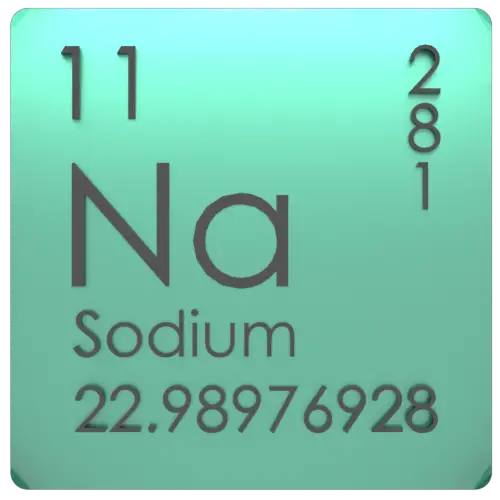
Source: www.luciteria.com
Other backdrop of Sodium
Source: https://material-properties.org/Sodium-protons-neutrons-electrons-electron-configuration/
0 Response to "what happens to sodium chloride when an electron is removed?"
Post a Comment